

Post #14
On Breath and Archive

“Are you breathing?”
“No, I’m not breathing at all, actually.”
This was the exchange last night as I played in the studio with Regina Martinez. Martinez, also remembered as selective listening, has a deep listening practice I find both haunting and energizing. She brings flag poles, stuck records, and her grandma’s whistling into conversation with one another and I can feel it in my bones. But when I asked if the looped cassette of her dad’s breathing at night encouraged her to sync her own breath to his, her response was, “I’m not breathing at all.”
I can relate. I’ve found it very difficult to catch my breath lately. Fred Moten’s plea for binocularity from just a few weeks into the genocide in Gaza continues to weigh on me. As Moten explains, this moment (which is perhaps only another side of that moment) demands “a kind of complex vision” which “allows us to look at something in a very specific, local context, but also globally. But also, we have to look at a particular moment — what Martin Luther King liked to call ‘the fierce urgency of now’ — but at the same time we have to understand that now operates and resonates within a longer trajectory.” This notion of seeing the thing through the binoculars as if it were so close you could touch it, and at the same time maintaining an awareness that there is a whole world (or worlds!) between you and the object of your gaze, and that your looking creates a frame which puts all these things in relation with one another… This weighs on me. Particularly if my looking is mediated by Meta or Amazon, or if my looking invites agentic AI to feed off of all the data that otherwise makes a life.
It is hard, these days, to remember to breathe.
So I was blessed to receive an invitation from David Thomson to gather with seven other artists and curators working across performance at the Lunder Institute last week for its Summer Think Tank.1 We were there, ostensibly, to discuss sustainability in our field, but with such an open-ended topic we ended up really getting into questions of risk, love, parasitic practices, and horizontal models of relationality. It was a thoroughly unproductive week: an opportunity to catch our collective breath. I realized, toward the end, that that is the work, too. Sitting down with folks you know or don’t know and finding where you align — and where you differently contour around shared values — is how we build the kinds of relationships we need to survive this moment (likely all of these moments).
We ended the week with questions, no answers.
Is there enough room for all of us – meaning all of us people but also all of what is inside of us? How do we make enough room? Should we make enough room? If we can’t make enough, what’s left?
How can institutions be more like trees? How can artists be more like oceans? What do institutions have in common with trees? What do artists have in common with oceans?
Can I dream as I walk as I live?
How do we love when we are under siege? (from the late Lorraine O’Grady)
Breath.
We also had a lovely moment with artist, archivist, and curator Cori Olinghouse, who runs The Portal (among other projects). I love thinking with Cori about what a “living archive” is and can be, how it can invite other ways of being with work but also with time and with bodies. There’s a quote Cori includes on The Portal website from Timothy Morton (my crush):
You can stroke a thing. You can eat a thing. You can ignore a thing. You can watch rain falling onto a thing. You can fly past a thing. You can burn a thing. You can love a thing. There’s nothing particularly special about ‘knowing’ that makes it the top access mode.
Period. Because what if we wrestled our relationship with a thing away — fully away — from this obsession with “knowing”? How does this free up the act of “looking”? What if we looked through the binoculars not necessarily to know, but to approach, to witness, to hold? What if we didn’t look at all? What if, as Timothy suggests, we loved?
And then — How strange that I should find myself joining the faculty at the University of Chicago Department of Visual Arts this fall. After seven years, I’ve left the School of the Art Institute of Chicago and moved down the street to take up the line left vacant by Pope.L’s sudden passing. The morning I received the email that I was being invited to campus for an interview and visit, I was standing waiting for the freight elevator in my studio building, scrolling. I was overjoyed, but I fixed my face as the elevator door opened and I stepped on to an unusually crowded platform. It was stacked high with crates and flat files; it seemed the elevator was carrying the entire studio of someone with a very robust practice. As we ascended, I looked around me. All of the crates had ‘Pope.L’ written on them with thick black marker. I was riding up the chute with Pope.L’s archive. Inconspicuously, I laid my hand on one of the crates.
I’ve written here before of how important Pope.L’s practice has been in terms of my own development as an artist and thinker. His work opened space for me and many others like me, and here, still, he was opening space. His practice continues to serve as a model, a provocation: How can the choice to live authentically function as a wedge to keep the door open? How can my own practice be one of spaciousness — how can I be more like an ocean? How can I love when we are under siege?
Breath.
In that same post I began re-publishing Endurance Tests, the column I wrote for Art Practical from 2013 - 2018 featuring interviews with black artists working across disciplines. In the spirit of the archive, I take this task back up almost a year since my last post. (Thank you, by the way, for enduring with me, allowing the pregnant pause, making room to catch the breath. I suppose this is the practice, too.)
Below is the conversation I had in 2018 with Edgar Arceneaux about his then-new performance Until, Until, Until…. I had the pleasure of seeing this work re-performed last year at the MCA here in Chicago and was struck by how much this piece feels like a time capsule. I suppose that as time speeds up, we may feel this more and more with work — perhaps particularly with performance work by artists of color and otherwise marginalized artists. I’ve certainly been saying as much about FORCE! an opera in three acts: The opera was born just before the uprisings of 2020 and put to bed just before 47 was re-elected, and is very much a work of its moment. As Faye Gleisser writes, there are “differently negotiated relations of racialized and gendered punitiveness” between white cis-het artists and artists of color and other marginalized artists (in Gleisser’s case, between Chris Burden and Asco, but I think this extends to artists working outside of “guerrilla art” tactics).2 I don’t believe this is always true, but I think it is often true, even when we’re not making overtly “political” work. (As a curator recently shared with me during a discussion about the difficulty of getting out of the red amidst an ever-dwindling donor base, even highly abstract conceptual performances featuring black bodies on stage are becoming a turn-off for white donor-audiences who feel they “don’t see themselves reflected in the work.”)
And yet, there is something about the way we tease out the stakes of our work through the work that keeps us in the practice of binocularity — the this but also all of that. I certainly saw that in 2018 in Arceneaux’s work, and I still do, though differently. I suppose the “all of that” part is a bit richer now…. so much has happened since 2018. In any case, I hope reprinting the conversation below can feel like a way to keep the archive alive.
“Endurance Tests” was an irregular column on current explorations of representation, the ethereal, and compulsiveness by black artists working in the field of performance. Across profiles and interviews, the column took seriously the proposition of performance as a repeatable and assimilable text. “Endurance Tests” examined contemporary performance-makers actively syncretizing the many implications of blackness: illegality, contagion, maladaptivity, and a privileged relationship to cool.
Edgar Arceneaux: Playing in the Black Hole
first published in Art Practical on January 30, 2018
Central to Edgar Arceneaux’s practice is a treatment of reality as diverse and time as multitudinous. Lately, he’s been making work that offers multiple and sometimes conflicting narratives about our Black heroes. Most recently, this involves making work about blackface.
In 1908, W.E.B. Du Bois acknowledged blackface minstrelsy as both an arrival and a loss, writing, "the Negro folk-song... the sole American music... [was] caricatured on the 'minstrel' stage and [its] memory died away."1 While the context and contours of blackface have been explored since the 19th century by scholars (most profoundly in Eric Lott’s Love and Theft) and more recently by artists (such as Iona Rozeal Brown), the subject remains sticky. Spike Lee's 2000 film Bamboozled—arguably one of the most compelling creative theses on minstrelsy—was criticized by Roger Ebert as "perplexing... [Lee] doesn't find a successful wayto express his feelings."3 Ebert contended that minstrelsy was unique in the panoply of social horrors in that it could not be satirized, that blackface is so highly charged "it obscures any point being made by the person wearing it."
Indeed, Arceneaux thought he would never touch the subject. “It was clear that blackface was presented in a moral framework that forced one to read it as either good or bad,” he told me, of early encounters with artists using the minstrel image. “It was a kind of black hole of meaning."
With Until, Until, Until... (2015—17), Arceneaux repurposes minstrelsy in an effort to reimagine what blackface could mean or do to a public. The work dives deep into the controversial performance that the award-winning Ben Vereen presented at Ronald Reagan's first inaugural ball, in 1981. Vereen performed as the legendary Bert Williams—one of the most famous vaudeville entertainers across racial lines—and began in blackface, as Williams would have. Vereen-as-Williams sang “Waiting for the Robert E. Lee” (“It's the good ship Robert E. Lee/come to carry the cotton away”), and the Republicans ate it up. In the second half of the performance, Vereen wiped off the blackface and sang the lament “Nobody” (“Who hands to me a glowin' kiss?/Nobody”). What was intended as a caustic commentary of the pain endured by all Black Americans was sabotaged by the network ABC, which only televised the first half, and Vereen's standing among the Black cultural establishment plummeted.
In 2014, more than thirty years after Vereen’s performance, and twenty years after Arceneaux saw a television documentary with sections of the unaired segment, Arceneaux happened to attend a birthday party at the Underground Museum, and Ben Vereen was sitting at the bar.
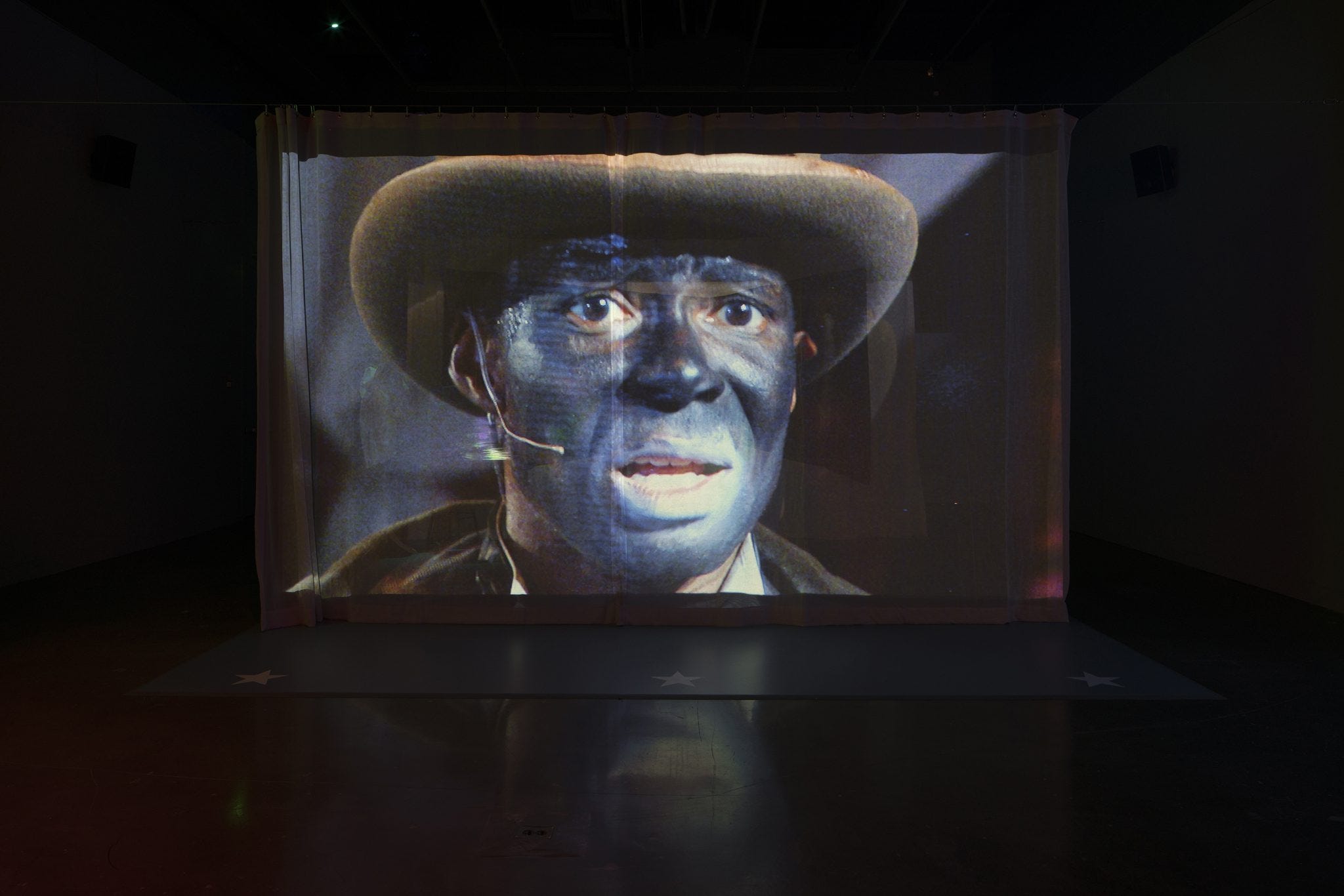
Edgar Arceneaux. Until, Until, Until…, 2016; installation view, Edgar Arceneaux, 2017–2018. Courtesy of the Artist and Susanne Vielmetter Los Angeles Projects. Photograph by Robert Wedemeyer.
Edgar Arceneaux: I thought the serendipity could mean something.
Anna Martine Whitehead: Because you remembered the documentary?
EA: Yes! Ben’s performance is so telling because you can’t fully reconcile it. You can’t say, “Hey, that was an awesome idea.” Nor can you say, “I wish you didn’t do it.” It happened, it exists, and it has something to say. We should try to figure that out.
AMW: I feel anxious even discussing blackface in 2018.
EA: When history presents itself so forcefully into the present, the essential questions are: What is it doing here, now? Why is it asserting itself in this moment? The idea there is that everyone and everything in my dreams is me; they just look like everybody else. They are vessels. By telling the story from that perspective, it allows me to take the blackface out of the center of the story.
AMW: So the blackface stops being a mirror and becomes a node; all these other elements—Reagan's inauguration, Ben Vereen in blackface, the "Just Say No" campaign, Bert Williams—can move through it or around it or away from it.
EA: I think of these events less like a line and more like a timescape. The conscious and subconscious are constantly struggling to give order to things, but serendipity and chance are evidence of how things move in trajectories through different times and spaces and can become aligned momentarily. And that alignment can give you a profound understanding.
To borrow language from Charles [Gaines]: There is a series of relays, where one thing points to other things; you start to recognize the qualities of one thing as a part of another, which appears to be radically different. My projects over the years have played around with that strategy. As you begin to look at one thing, it propels you to look at another thing.
AMW: I’m thinking of two of your works, A Book and a Medal (2014) and The Library of Black Lies (2016).

Edgar Arceneaux, Library of Black Lies, 2016; installation view, Edgar Arceneaux, 2017–2018. Courtesy of Yerba Buena Center for the Arts. Photograph by John Foster Cartwright.
EA: The Library of Black Lies is both a library and a labyrinth. Labyrinths are made to be deeply introspective. The idea of getting lost in the three-dimensional space is analogous to getting lost inside of yourself. I was trying to draw some analogy between the idea of the labyrinth having a center as well as a dead end, and how I believe we actually learn. Often when I’m reading, I’ll come across a word or a phrase, and my mind just wanders off. The mind works like that. It moves in counterintuitive ways. When you walk into The Library of Black Lies, you see these bound books, and if you’re courageous enough to open them, you realize that they are made of newspaper. When you get to the center of the labyrinth, you discover old encyclopedias of Christianity, and buried in there are Bill Cosby books.
AMW: Why Cosby?
EA: I was thinking about the way history is taught. Americans like our history to be triumphant. In the trajectory of Black accomplishment, what do we do with Bill Cosby? What do we do with The Cosby Show, when so much of it influenced our art and ideas of what family looks like in the 20th century?
There is one worldview that assumes that the art that we make and the lives that we live are so entangled that there are no fictions, that the art just expresses everyday life. I think that there’s always an overlapping yet distinct relationship between identity, the environment, and the self. This is how I locate a space of freedom within the equation of race and identity.
AMW: Is this worldview informed by a spiritual practice? It sounds connected to something much bigger than yourself.
EA: Talking about serendipity is a way for me to try to come to terms with both visible and invisible forces that affect us and shape our experiences—big bangs that happened decades earlier. That was one of my profound understandings while working in Watts. [From 2007 to 2013, Arceneaux initiated and ran the Watts House Project, an artist-housing collaborative.] The problem is immense. What created it in the first place? Looking back fifty years, it was the snipping away of the social safety net: Redlining practices have had this ripple effect down generations, regarding who gets to go to college and who has access to credit and who gets to own a home.
The Watts project didn’t work out the way I had intended it to. What began as a façade-improvement project grew into an 85-person operation with hundreds of thousands of dollars of fundraising. It took on a life of its own. I was shamed in the press and had this sense of failure, and I wasn’t certain I would ever get over it.
Before that time, in 2006, my daughter was born, and I saw analogies between the life of an organization and the life of an organism. They both need to learn how to live and breathe and eat. They get sick. They need attention.
AMW: That year, you started working on themes addressing the ultimate charismatic community leader, Martin Luther King, Jr., which would be manifested as A Book and a Medal and A Time to Break Silence (2014), your meditation on MLK in the sci-fi dystopia of late capitalism.4 It's interesting that, with Ben Vereen and Bert Williams, you have returned to troubling the charismatic-leader narrative. Obama would have also made sense as a subject. What does it mean for you to do Until, Until, Until… in this political climate?
EA: My desire for this show is to be able to travel to as many Red and battleground cities, counties, and states as we can afford to. Part of the reason Trump got elected is because we weren’t talking to each other, and maybe this is an opportunity for that.
Ben discussed his motivation for playing Bert Williams, telling Frank Lawson [who plays Vereen, Vereen-as-Williams, and Donny Osmond in Arceneaux’s work], “You need to tap into that inner pain: that bartender is calling you a nigger.” We were trying to get Ben to understand that Frank’s not playing Bert Williams; he’s playing Ben playing Bert Williams. But Frank does not have to become Ben becoming Bert to perform the impacts of racism.

AMW: Midway through the show, the audience must watch a video of themselves watching a blackface performance.
EA: Ben showed me the video of the full 1981 performance, which he hadn’t seen in a couple of decades. He sat down cross-legged on the floor in front of the TV, which was close to the floor, and I sat behind him cross-legged in a chair. I was watching him watching himself perform somebody from a hundred years ago. It conveyed this great expanse of time. And I wondered: When did this performance begin? When does it end? Does it end with me? So I wrote that scene into the play.
The Lunder Institute Think Tank (Re)imagining Sustainability ran from July 14 - July 18, 2025 and included myself, David Thomson, Rashida Bumbray, Zachary Fabri, Jonathan González, Autumn Knight, Cori Olinghouse, taisha paggett, Julie Tolentino, and Tara Aisha Willis.
Faye Gleisser, Risk Work: Making Art and Guerrilla Tactics in Punitive America: 1967 - 1987 (University of Chicago Press, 2023), 38.
Roger Ebert, "Bamboozled," October 6, 2000, https://www.rogerebert.com/reviews/bamboozled-2000
An excerpt of A Time to Break Silence can be viewed at: Zing Tsjeng, “What Links Martin Luther King, Detroit techno, and Kubrick?” Dazed, October 7, 2013, http://www.dazeddigital.com/artsandculture/article/17476/1/what-links-martin-luther-king-detroit-techno-and-kubrick